Chapter 20-23
- So many different types of networks.
- Computer networks existed before the Internet.
- There were different basic technologies used.
- Even with the underlying technology, manufacturers made incompatible designs.
- The Defense Advanced Research Projects Agency (DARPA) (or
occassionally just ARPA)
makes grants to research universities.
- Many of these grants involved purchasing of computers. (Back when one computer was a large expense.)
- DARPA wanted to reduce the number of computers by allowing researches network access.
- Different groups wanted different types.
- So DARPA started studying how to network computers over different types of incompatible network.
- It's a hard problem.
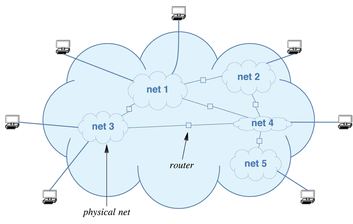
- The text calls a box which connects different types of network a
“router,” though I don't know that's the usual use of the term.
 Format A; 10-bit addresses; Packets max 4096 bytes; no session id;Format B; 2-part addresses, 10 bits and 20 bits; Packets max 1000 bytes; numeric session id;Format C; 32-bit addesses; Packets max 1500 bytes, min 200 bytes; no session idFormat D; 20-bit addresses; Packets max 1024 bytes, must be a multiple of 16; text session id
- Different nets use different formats and protocol rules; routers have to convert.
- Lots of possible differences:
- Packet size and format.
- Forward error correction v. acknowledgement.
- Line access protocols.
- Host name format and meaning.
- Packet size limits.
- Conversion is hard
- How do you forward a packet when it is too large? You'll have to break it up, but how do you tell the receiving network that it's multiple pieces?
- How do you send from a host on network A to a host on D, when the naming scheme is completely different?
- How do send a message from an network that uses FEC to a recveiver that doesn't even use parity codes?
- etc.
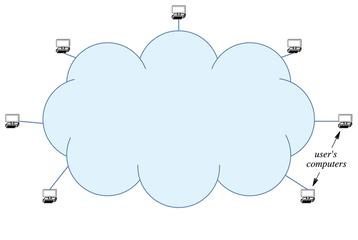
- Better solution: The virtual network.
- This is none of the networks we are trying to unite; it is an abstraction, much like a software interface.
- It exports an abstract set of network operations implemented with
whatever hardware is available.
- The virtual network is build in software, and has its own packet format, addressing scheme and protocols.
- These are implemented using the various hardware networks with different properties.
- The routers in the above picture
- Do not try to convert packets from one network format to another.
- The receive an Internet packet as the payload from one network, and send it out again as the payload over the out-bound network.
- The TCP/IP protocol suite implements our Internet.
- There's no reason why a different protocol could not implement an internet in a different way, but no one has found a reason to make one.
- Research first funded by DARPA, then the National Science Foundation (NSF).
- Transitioned to commercial when it became obvious that was needed.
- The stack again:
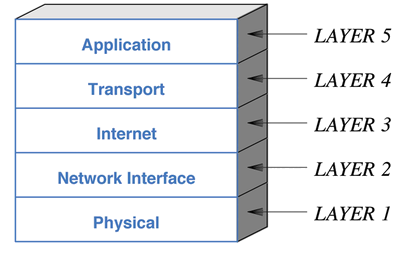
- The Internet layer implements the software abstraction.
- Layers above Internet operate entirely with IP datagrams (the abstract network). They operate exactly the same way on any Internet host.
- The Internet layer and below depend on the type of network in use. A computer connected to different types of network will need different versions of these for each type.
- The Internet layer sends to and receives from the Network Interface layer packets conforming with the hardware network rules.
- The Network Interface layer sends and recevies hardware packets using the particular hardware involved.
- Hosts and Routers
- A host is any attached computer that runs applications.
- Routers are attached, but do not run applications.
- Plain routers need only IP protocol layers 1, 2 and 3.
- Firewalls are special routers, and will need to understand level 4.
- There are two versions of the Internet Protocol.
- The common one is (still) version 4.
- Version 6 has some advantages, but is not widely used by consumers.
- The text calls a box which connects different types of network a
“router,” though I don't know that's the usual use of the term.